
.png)
At Maple VC, we don't just invest early. We invest first.
We built Maple around a belief: the best seed investors recognize greatness before the data can prove it. If you talk to any of our founders, they’ll tell you: Maple was the first believer.
Today we celebrate one of the biggest milestones in Maple’s portfolio: Clay crossed $100M ARR, just two years after passing $1M.
It’s a surreal moment to reflect on — especially because Clay was one of the very first investments in our first fund back in 2017. What looks obvious today was deeply non-obvious then, and the journey to this point was anything but linear. It took a founding team with rare creativity, relentless truth-seeking, and clarity of vision to make it real.
The Maple VC Investment Frameworks
Writing the first check is different from following a trend. At Maple, we apply two frameworks that shape our conviction: The Talent Framework and the Investment Framework.
The Talent Framework
We believe every great company is built by a combination of three archetypes:
- Inventors: Ideators who spark breakthrough ideas and new shifts before others.
- Builders: Visionaries who turn these ideas into products—and attract talent and capital.
- Operators: Executors who operationalize and scale organizations.
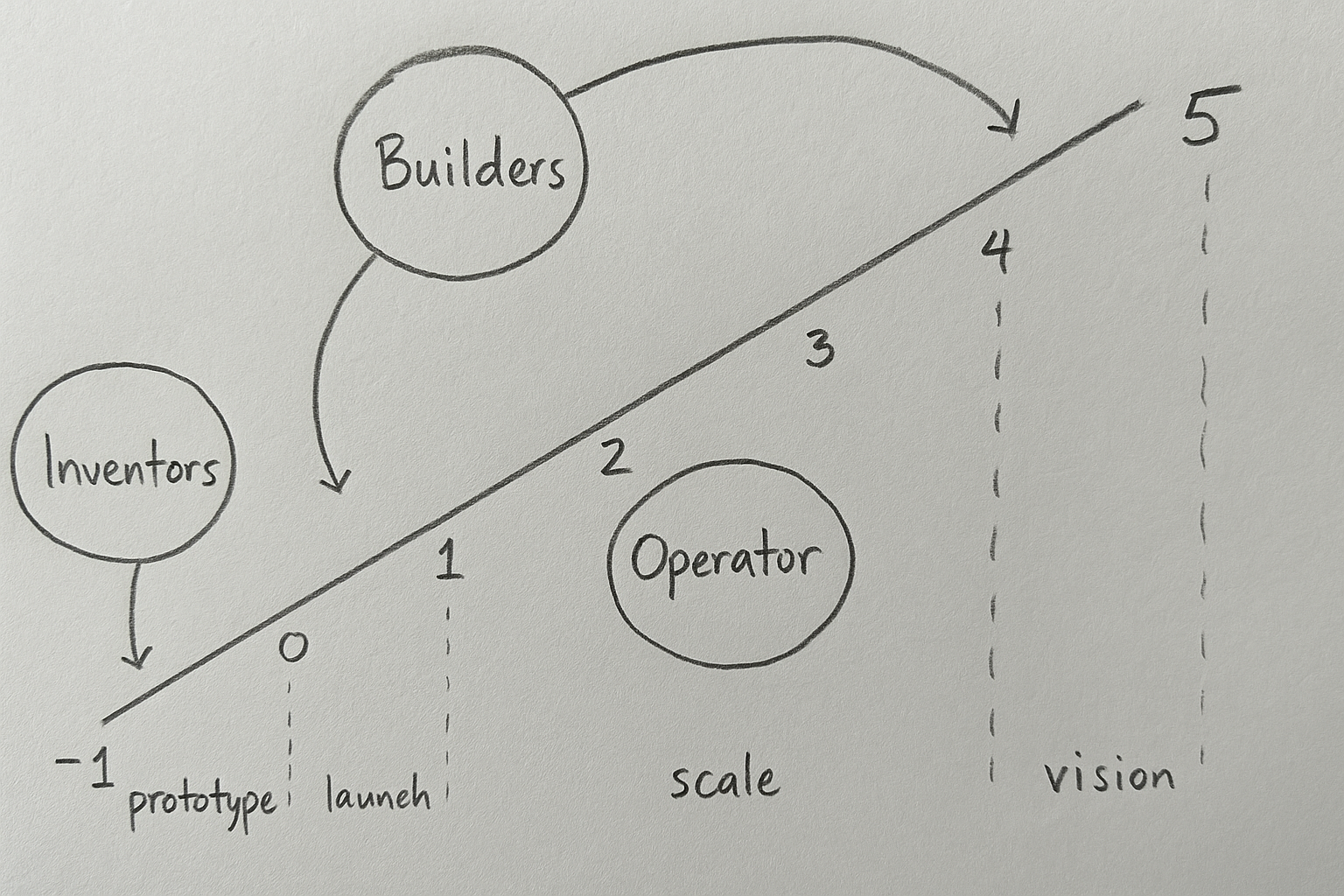
Most investors tend to gravitate toward Inventors or Operators who usually have polished narratives or traction. But Builders? They're often the most misunderstood. They may not come from the industry. Their pitch might be raw. But they have the rare ability to bring ideas to life and attract the right people around them. In our experience, if a founding team includes a Builder, the other archetypes will follow. Without one, long-term upside becomes limited.
One example we think of is Google: Sergey Brin (Inventor), Larry Page (Builder) and Eric Schmidt (Operator, who joined later). That combination is what built an enduring company.
The Investment Framework
When evaluating a founder and idea at the earliest stage, we ask six key questions:
- Tech: Is this a 10x better solution?
- Timing:
- What technology makes this possible today vs a few years ago?
- What’s driving customer willingness to pay today vs before?
- What cultural shift makes this business viable today?
- Monopoly: Can they dominate a niche market?
- Distribution: How will they creatively reach customers?
- Defensibility: What strategic asset will protect them long-term?
- Secret: What unique insight do they believe that others don't?
Thanks to Peter Theil’s Zero to One book combined with our first hand experience being early at legendary companies like Uber, this framework helps us spot hidden outliers from the earliest stages.
Why We Wrote the First Check into Clay — 2017
We were introduced to Kareem Amin and Nicolae Rusan through fellow Canadian expat Michael Hershfield (now also a proud Maple founder of Accrue). It wasn’t our first time crossing paths, but it was the first time they shared the seed of a new idea:
What if non-engineers had their own version of the developer Terminal—something just as powerful, intuitive, and limitless as the tools developers use to write code?
They envisioned the spreadsheet as that environment—a familiar interface reimagined to give non-engineers superpowers. By connecting the spreadsheet to the internet for the first time, they posed a bold question: Could this become a programmable canvas where anyone in the enterprise—not just developers—could build, automate, and create like a programmer?
At the time, Kareem wasn’t pitching a deck or walking through a demo. He was articulating a vision that captured our imagination: making programming accessible to all.
He spoke about how serverless technologies like AWS Lambda paved the way for no-code/low-code platforms that empower non-technical users to build software. When we asked what kind of applications those users might build, he pointed to every team outside engineering—sales, marketing, recruiting, operations, growth.
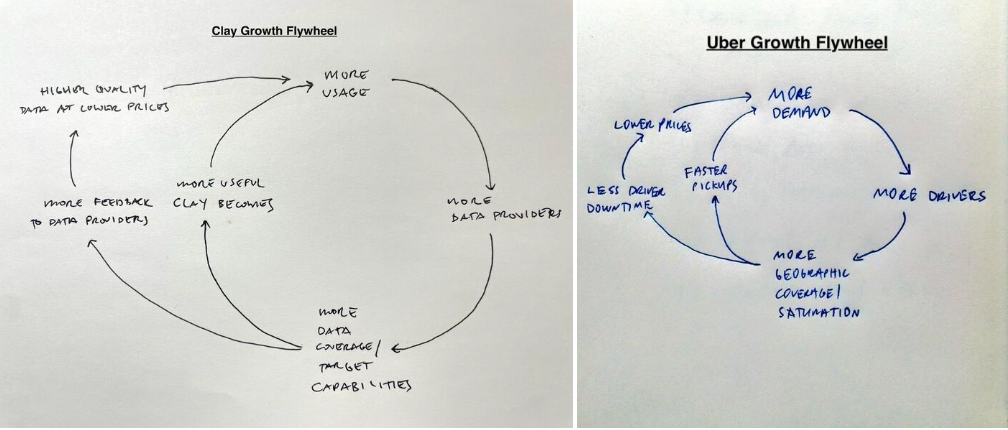
As we worked through the six questions we like to ask founders, one stood out to us: defensibility. Kareem described Clay as “a marketplace for API functions that instantly run results—without writing code.” While very little is obvious at the earliest stages, our background at Uber helped us appreciate the potential for network effects. (See below: a version of the flywheel we drew years later, where API functions = data providers.)
Lastly, when asked what he believed that others didn’t, Kareem replied:
“Education won’t solve the supply-demand imbalance of engineers. We need to give superpowers to non-developers.”
At the time, in 2017, AI was not mainstream and that belief was far from consensus. Bootcamps to train engineers were booming. Andre was at Hired, where the mission was to better match companies with engineering talent. Kareem’s perspective felt non-obvious—and refreshingly different.
Here is a summary of our notes to the six questions:
- Tech: Ability to create software products without writing any code
- Timing: Coinciding with the rise of no-code / low-code tools tools and serverless tech
- Monopoly: Focus on non-developer teams inside growing companies
- Distribution: Leverage SEO on Google for each API function
- Defensibility: Marketplace of API functions that instantly run results without writing code
- Secret: Education is not going to solve the supply / demand imbalance for engineers.
What also stood out: the founders.
At the time, they hadn’t appointed a CEO, and we weren’t sure who the Inventor or Builder was. What stood out instead was how seamlessly both Nicolae and Kareem moved between the two archetypes. They could operate as Inventors, articulating entirely new technical paradigms and challenging long-held assumptions about how software should be built. And just as naturally, they could switch into the Builder role – translating those ideas into something immediately tangible.
A few years later, Varun Anand joined as the Operator, scaling the systems and processes behind the scenes.
Most startups begin with just two founders—and that’s okay. As long as one of them is a Builder. That role attracts the others. That role makes the difference.
We’re proud to have been one of the first believers in Clay back in 2017 before a single dollar of revenue. We’re equally proud to have stayed constant during the wilderness years, when others didn’t seem to be around. We believe that conviction put us in a position to fortunately triple down on the company at the Series A+ and Series B rounds—investing the largest aggregate check (~$15M) we’ve ever written into a single startup.
A big thank you to Kareem for having us along for the journey since day one.
Where Clay is Headed
Today marks a defining milestone. Clay has crossed $100m ARR, up from $1m just two years ago.
But the metrics only tell part of the story. The outputs are remarkable because the inputs — a strong foundation, a unique culture with unapologetic creativity — are exceptional.
- >200% Enterprise NRR — not a single enterprise customer has churned.
- Each $1 invested grows 15x — a ratio that’s tripled in recent years.
- GTM Engineering as a category — thousands of jobs created, hundreds of agencies, and 70+ self-organized global clubs.
What began as a no-code spreadsheet is now the operating system for GTM Engineering — a category Clay defined and continues to lead.
And despite crossing $100M ARR, Clay is still early in its journey. The imagination of what Clay can become is just starting to unfold. We are incredibly proud of their 8-year overnight success!
At Maple VC, First Check isn’t just an investment strategy—it’s a philosophy.
We believe in Builders—before the world does.